Look Again July 15 – October 10, 2010
Artist List Chul-Hyun Ahn (b. 1971 Busan, South Korea; Lives: Baltimore, USA) Christian Andersson (b. 1973 Stockholm, Sweden; Lives: Malmo, Sweden) Daniel Arsham (b. 1980 Cleveland, Ohio; Lives: New York City, USA) Tara Donovan (b. 1969 Nyack, New York; Lives: Brooklyn, USA) Chris Dorosz (b. 1972 Ottawa, Canada: Lives: San Francisco, USA) Tim Hawkinson (b. 1960 San Francisco, California; Lives: Los Angeles, USA) Houston (established 1971, USA)
Jamie Isenstein (b. 1975 Portland, Oregon; Lives: New York City, USA) Diane Landry (b. 1958 Cap-de-la-Madeleine, Canada; Lives: Quebec City, Canada) Jorge Macchi (b. 1963 Buenos Aires, Argentina; Lives: Buenos Aires, Argentina) Adam Putnam (b. 1973 New York City, New York; Lives: New York City, USA) Max Sudhues (b. 1977 Munich, Germany; Lives: Berlin, Germany) Mary Temple (b. 1957 Phoenix, Arizona; Lives: Brooklyn, USA) Frances Trombly (b. 1976 Miami, Florida; Lives: Miami, USA)
Kumi Yamashita (b. 1968 Takasaki, Japan; Lives: Brooklyn, USA) Curated by Steven Matijcio Curator of Contemporary Art, SECCA
Cover: Kumi Yamashita Exclamation Point, 1995 Wood, light, cast shadow Photo courtesy of the Artist and Kent Gallery, New York
In a time when virtual worlds, synthetic products, staged events and political rhetoric have fused our physical environment with ubiquitous deceit, the notion of illusion occupies almost every facet of our being. Beyond the canvas, object, and tricks exclusive to the eye, artists are re-employing the trompe l’oeil (“trick of the eye”) tradition as a contemporary vehicle for revelation and disclosure. Look Again explores these ideas from an international purview, congregating artists that employ everyday materials to build and break the daily deception we call reality.
In the latter half of the 20th century, new technologies and advances in perceptual theory began to expand the implications of trompe l’oeil, even as its profile waned in the political context of postmodernism. At the dawn of the 21st century this decline has begun to reverse course in a dramatic way, as evidenced by exhibitions like the Getty’s “Devices of Wonder: From the World in a Box to Images on a Screen” (2001-02) and the National Gallery of Art’s “Deceptions and Illusions: Five Centuries of Trompe l’Oeil Painting” (2002-03). In the process, the politics of perception (present to varying degrees throughout art history) are drawn to a finer point in work that purposefully raises the curtain on the construction (and ubiquity) of illusion. In the context of pervasive political spin – where the very notion of “revealing” deception (i.e.
Watergate) is antiquated by a continuous stream of official misdirection, semantic shellgames, and media spectacle – this project becomes a lens to decipher the notion of the everyday mirage.
Chul-Hyun Ahn Mu Rung Do Won (Infinite Garden), 2008 Plywood, lights, mirrors, plants, rocks, branches Photo courtesy of the Artist and C. Grimaldis Gallery, Baltimore
Christian Andersson Soft Drink Stand, 2001 Wall, slide projector, slide, lights, Plexiglas, acrylic paint Photo courtesy of the Artist and Galerie Nordenhake, Stockholm
Chul-Hyun Ahn
Christian Andersson
The work of Chul-Hyun Ahn is heavy and hallucinatory at once, straddling the real and the virtual as he constructs physical structures that frame enigmatic voids. Trained as a painter in his native South Korea, Ahn translates two-dimensional elements and principles of design (line, shape, rhythm) into three-dimensional “windows” that marry physical and optical navigation. Piercing walls, floors and all manner of architectural edifice, his installations extend our perspective across infinity: refusing culmination to drift in contingency. This viewpoint is made all the more surreal when surrounded by plywood, cinder block, rocks, fallen branches, fluorescent light tubes, and other industrial materials he employs to create supernatural portals. In so doing, Ahn marries Constantin Brancusi’s “truth to materials” and the austere minimalist sculpture of Donald Judd and Dan Flavin with the ethereal experiments of the 1970s Light & Space movement (including James Turrell and Robert Irwin) and Olafur Eliason’s integration of natural materials into illusory space. At the intersection, he makes little effort to conceal the make or manufacture of his work – arranging a combination of one and two-way mirror panels within imposing structures to produce a weightless realm of infinite depth. Like cryptic reflecting pools, they entice viewers to peer into a world we cannot enter or appear. Instead, conjuring “the great nothingness” of nirvana amidst the coarse weight of Western industry, Ahn fuses endlessness and emptiness into works that contemplate absence.
Seeing the past as a necessary, if problematic lens to view the present day, Christian Andersson questions the often-unquestioned integrity of history, archives and memory.
His inquiries take the form of interruptions in the linear trajectory of time, congregating (and conflating) images, texts, references and objects from pre-history to the 21st century. The ensuing intersections fuse research, mythology and art-making: re-routing historical paths of information into a chameleon-like variety of cross-disciplinary alternatives. Despite their consequently diverse aesthetics, Andersson’s installations find common ground in an irreverent language of de-constructed and re-constructed fragments. From paperback novels, VHS videocassettes and movie posters to lava lamps, flying bricks and phantom light sources, he assembles speculative models from the debris of popular media. As a case in point, F for Fake (2002) updates Orson Welles’ 1976 filmic investigation of authorship and authenticity into a surreal tableau where a single, non-descript stage light appears to cast a pair of shadows. As a shroud of doubt subsequently spreads across the surrounding structure, Andersson meditates on the idea of the artist as magician. With subtle sleights of hand – turning the double-take into a recurring device for subverting dominant norms – he animates this idea and creates a space where audiences can formulate alternative orientation/s.
Across his entire body of work, Andersson turns artifice into the opportunity for revision: conjuring illusions that challenge the certainty of absolutes.
Daniel Arsham Curtain, 2007 EPS foam, plaster gauze Photo courtesy of the Artist and Galerie Emmanuel Perrotin, Paris
Tara Donovan Bluffs, 2009 Buttons, glue Photo courtesy of the Artist and The Pace Gallery, New York Photo by: Kerry Ryan McFate
Daniel Arsham
Tara Donovan
Responding to the seemingly contradictory marriage of design and decay that informs this young artist’s practice, writer Melissa Maerz argues, “Daniel Arsham makes architecture do all the things it shouldn’t.” Rather than function and stability he moves paradoxically, but purposefully in the opposite direction: cutting, breaking and disintegrating. In his aim to “relax” the solidity of architecture with the messy presence of natural processes, Arsham describes his program of engineered entropy as “architectural intervention.” Alongside colleague Alex Mustonen, he has turned this approach into a burgeoning business titled “Snarkitecture,” which has, among other projects, designed public art for a baseball stadium and an insert in the Miami Herald. Arsham has been equally active in his personal movement between art and architecture, designing fitting rooms for the Dior Homme Boutique in Beverly Hills, set pieces for some of choreographer Merce Cunnigham’s last performances, and a permanent installation in a Carnival cruise ship. He does so using a combination of cut-outs and EPS (expanded polystyrene) inserts, working inside walls to incorporate existing architecture into hybridized spatial experiences. Fusing organic and synthetic models, Arsham implicitly confronts the rigid “universalism” of International Style modernist architecture and its exclusion of the human body, cultural difference and structural fallibility. Deconstructing this geometric language from within, his walls melt, ripple, bulge, droop and break down – shedding the artificial façade of timelessness to embrace imperfection.
Mundane processes and materials take on a magical aura in the work of Tara Donovan, turning common consumer objects into elemental marvels. From shirt buttons, paper plates and plastic drinking straws to toothpicks, Styrofoam cups and paper clips, she re-purposes everyday items into cell-like components. In their ensuing accumulation and arrangement, Donovan locates unforeseen promise in materials perpetually associated with cheapness, waste and excessive consumption. The transformation is a product of years of experimentation with mass-produced minutia; developing what Donovan calls “a dialogue with each material that dictates the forms.” These forms “grow” through meticulous, repetitive means; applying a single action to a single material countless times to transcend the monotony of making. Her working process is laid as bare as her materials, which makes the destination all the more dazzling. With what the artist calls, a “mechanized process without the luxury of a machine,” junk gradually, almost super-naturally, takes on the aura/appearance of organic phenomena. From fog banks and coral formations to stalagmites, clouds, sand dunes and ice floes, she defies the laws of nature to mimic earthly formations.
However, this stirring aesthetic reclamation raises the question: Do Donovan’s spectacular works deflect anxieties about the consequences of worldwide consumption, or do they offer poignant meditation on the wonders that can be found in the most banal of places? The answer, like one’s perspective of this work, ebbs and flows.
Chris Dorosz The yellow pillow [detail], 2010 Acrylic paint, tape, monofilament, wood Photo courtesy of the Artist and Leo Kamen Gallery, Toronto
Tim Hawkinson Foot Quilt, 2007 Silver polyester fabric, Dacron batting Photo courtesy of the Artist and The Pace Gallery, New York Photo by: Joshua White
Chris Dorosz
Tim Hawkinson
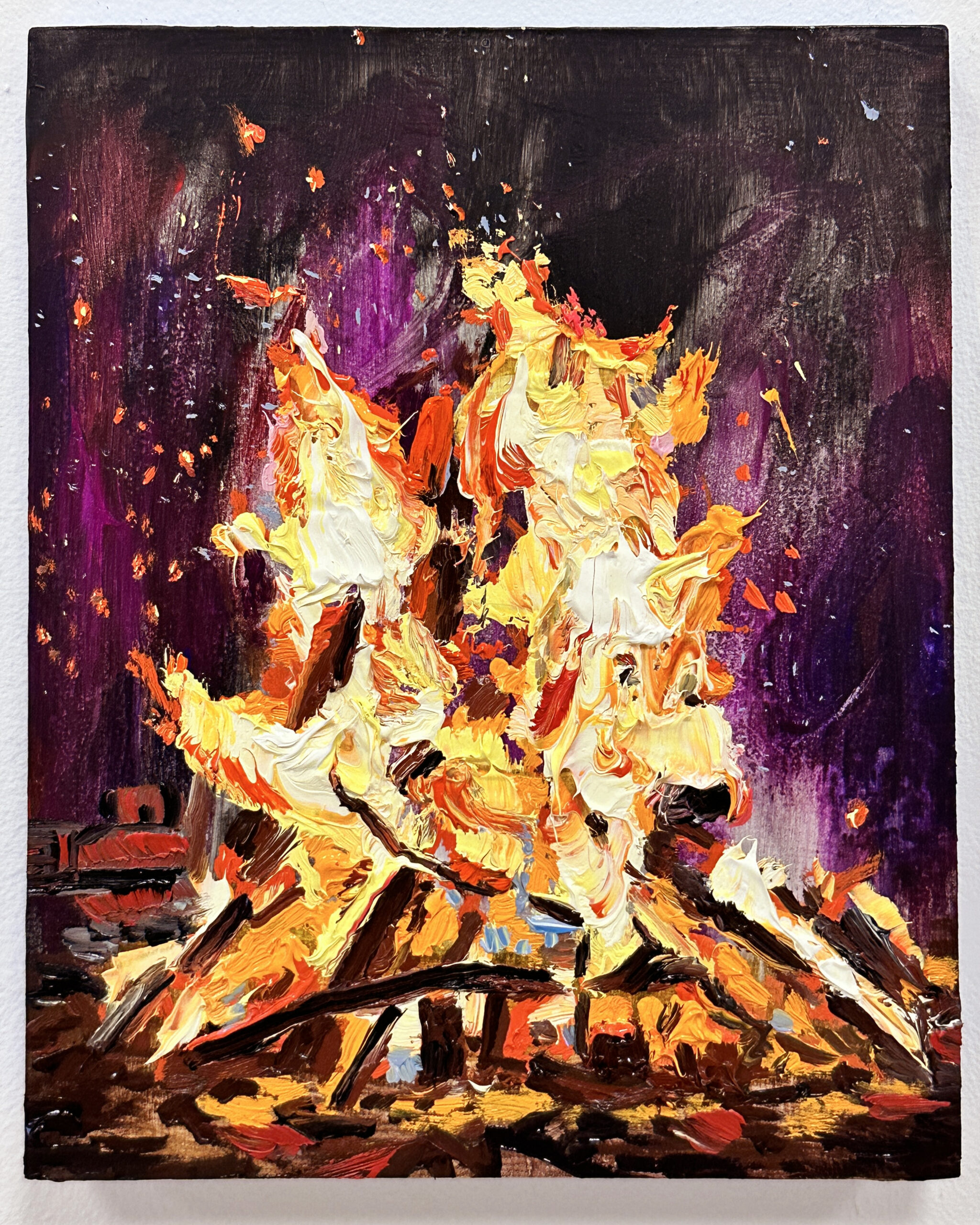
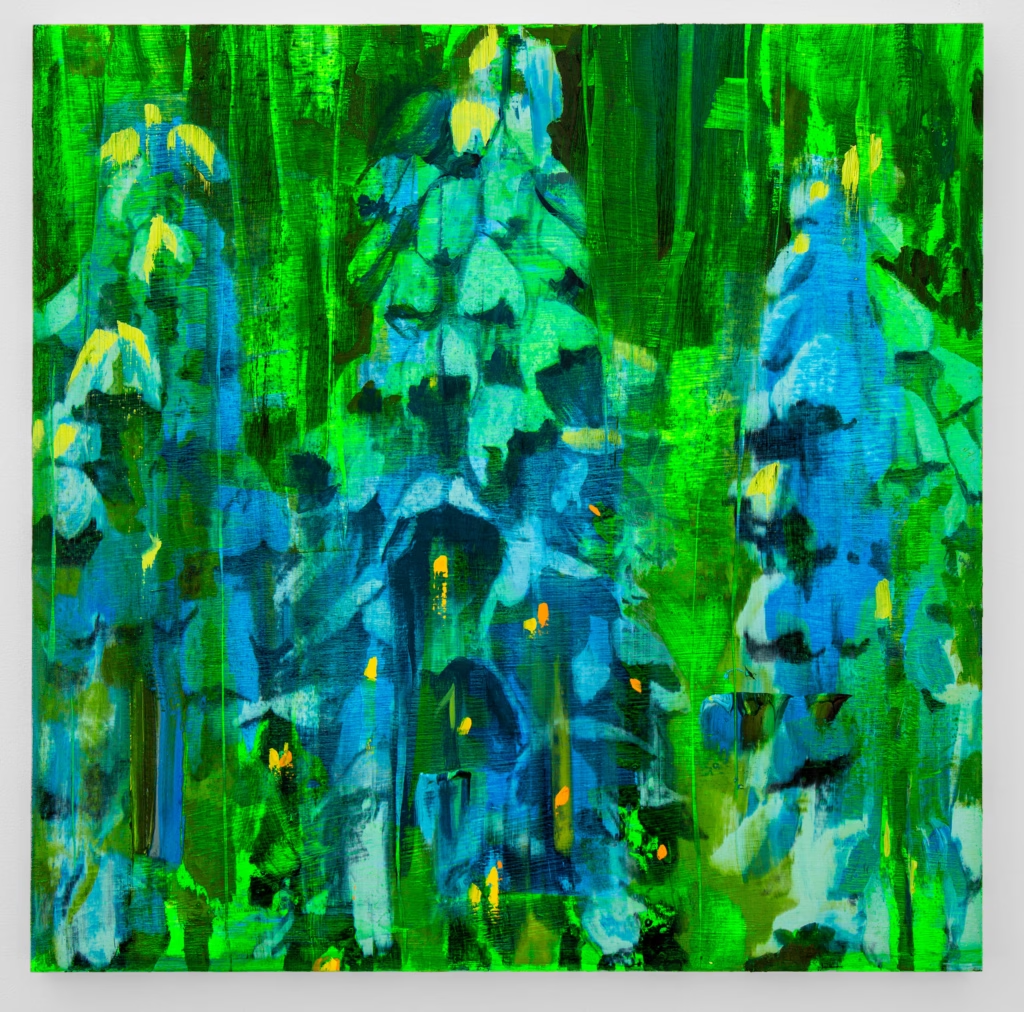
Dorosz re-imagines the possibilities of painting on an atomic level – moving away from the canvas and brush to (re)create subjects and settings one molecule at a time. Finding parallels across models of science, technology and art, he sees the drop of paint as the basic unit of representation, akin to DNA in the human body, and pixels in/on a computer screen. From this base-level foundation, Dorosz atomizes and re-orients the constitution of images, objects and settings: taking “apart” their physicality to analyze accumulations of memory, value and meaning. The ensuing works take similar actions upon the viewer, casting the certainty of one’s gaze into doubt as Dorosz dissolves the solidity of his subjects into clouds of suggestion. In so doing, his painstaking aggregation of individual paint daubs updates the early 20 th century practice known as “Pointillism,” and its later translations in commercial printing processes, Cathode Ray Tubes and digital pictures. Yet far from the pristine image these media present, Dorosz’s atoms are unabashedly imperfect globules that lay bare the visceral, fallible, and quintessentially human side of their fabrication. The surrounding light, shadow, space and audience are as much a part of the work as the paint and monofilament, collectively “thickening” the air as Dorosz’s apparitions shiver with ambient motion. In the process, he unfastens the assuredness of both the image and its apprehension; evading focus to float in contingency.
Known as the mad scientist of the museum world, Tim Hawkinson gives “life” to brilliantly absurd objects that map history and humanity from the rubble of our cast-offs. And while his profile has risen to the upper echelons of the art world over the past fifteen years, his practice remains neurotic, obsessive and fervently DIY. Contrary to the Hollywood sheen that surrounds his southern California studio (where he has worked since grad school), his materials are largely scavenged and he refuses to outsource any part of his prolific production. From cardboard, spent pens, dust and garbage to finger nail clippings, hair, soda cans and broken TV antennae, Hawkinson speaks in/ through the detritus of self and society. The ensuing cartography positions man as the measure of an increasingly bizarre world. Fusing self-portraiture and sculpture in maniacal, yet methodical systems, Hawkinson casts and multiplies his body to create surrogates that explore (and illustrate) the idiosyncrasies of human behavior. In past work he has visualized the history of man with a circuitous drawing reminiscent of an intestinal tract, and mapped the expanse of an elephant’s body by the path of a blind man’s hand. Across an equally vast spectrum of scale and perspective, Hawkinson’s collection of self-portraits continues to multiply at a prodigious pace. From micro to macro, a minute bird skeleton constructed from his fingernail clippings stands just over an inch high, while Überorgan fills a 300-foot long gallery space with massive, inflatable organs that play musical scores from a piano machine. The tune, like that of all his work, hums with unexpected life, and possibility.
Houston Rendition, 2006 Steel, wood, plastic, feathers, latex paint Photo courtesy of the Artist/s
Jamie Isenstein Arm Chair, 2006 Wood, metal, nylon, raw cotton, linen, hardware, zippered jeans, “Will Return” sign Collection of Andrew Ong, Courtesy of Andrew Kreps Gallery, New York
Houston
Jamie Isenstein
While it is unclear if “Houston” is a product, person, group, corporation or idea, the uncertainty is an integral part of this entity’s program. Yet while the identity of Houston remains shrouded, the impetus of its work is urgently expressed in the entity’s website address, which appropriates the infamous Apollo 13 distress call: “We have a problem.” In this case, the “problem” refers to the increasing perversion of the American Dream into a stew of imperialism (Westward Expansion; Manifest Destiny), consumerism and colonization. The ambivalent marriage of aesthetics and violence that accompanies this campaign informs the corporate vocabulary of Houston, where product and packaging are indivisible. As such, the Houston logo adorns a line of pastel-colored, industrially fabricated designer “items” that push the limits of stylized bloodshed. The centerpiece of this spectacle is a seductive arsenal of arrows, switchblades, syringes and tomahawks imbued with equal amounts of style and societal pathology. Arranged in orbits/mandalas that speak to the overlap of spirituality and force, Houston’s weaponry pierces walls, trees, file cabinets, furniture and numerous other barriers it sees obscuring the flow of information. When puncture takes place, Houston simultaneously implies and negates a living surface below as streams of “blood” trickle down in the pastel hues of its weapons. Coming full circle in content and composition, this entity animates the way physical and political violence is aestheticized, branded, and normalized.
Marrying earnest meditation on the passage of time with vaudeville-inspired performance art, Jamie Isenstein (literally) animates the ambivalence of vanitas painting. Like the P.T. Barnum of time-based practice, she stages deceptively simple tableaux that become uncanny through restrained, yet demanding “inhabitation.” Stepping into semi-hollowed objects and sets, she re-examines the relationship between artist, artwork and audience, as well as that connecting/dividing sculpture and performance. Inside walls, chairs, magic boxes, suitcases and behind curtains, she lives within her work for hours upon end – passing the time while attempting to remain perfectly still. These actions require considerable endurance and dexterity, but the aura of the performer is left “backstage” as Isenstein remains loathe to show her face or be seen entering/exiting a work. Instead, she turns the focus onto the larger notion of human life as sculpture: challenging the immortality and certainty of an art object forced to linger in states of contingency. When she temporarily vacates the respective work, Isenstein leaves what has now become a signature blue & white “Will Return” sign, complete with clockface and adjustable red arrows (to indicate the hour of her expected return). In so doing, she simultaneously extends the performance/ritual and discredits the sign – creating a stark reminder that nothing is forever, and that one day far in the future, the performer will not return.
Diane Landry Mandala (Naya) [detail] from The Blue Decline series, 2002 Plastic water bottles, plastic laundry hamper, motors, tripod, aluminum, halogen lamp Photo courtesy of the Artist
Jorge Macchi Horizonte (Horizon), 2002 Nails, desk lamps Photo courtesy of the Artist and Galeria Ruth Benzacar, Buenos Aires
Diane Landry
Jorge Macchi
Diane Landry translates banal consumer items and motorized systems into the fodder for mythologies, meditations, and magical alchemy. Sliding fluidly between installation, sculpture, video, photography and performance, she marries a variety of approaches to transform inanimate objects into the seeds of sentience. Like a scrapyard version of Disney’s Fantasia, Landry pushes the basic functions of her respective materials into fanciful possibility. Re-imagining the role of the domestic apparatus, everything from water bottles, laundry hampers and salad spinners to umbrellas, bed frames and washing machines are imbued with unexpected life. She describes the kinetic results as oeuvres mouvelles (“moving works”), which, with basic mechanical rigging and a cobbler’s approach to automation, appear to live and breathe. Where light symbolizes life, Landry’s “palette” of metal and plastic spins, shudders and dances in an increasingly rhythmic fashion. Every movement fuses the legacy of Muybridge’s motion studies (of both humans and animals) with the ambivalent possibility of artificial intelligence. Landry also channels early cinematic devices, zoetropes, magic lanterns, and phantasmagoria. The latter is especially prevalent in her practice, as she orchestrates light and shadow to animate systems with activity that falls somewhere between haunting and hallucination. Whether these works speak to the sins of disposable culture or the untapped promise of the everyday, it is clear that Landry’s mechanized entities inspire a re-evaluation of the material world.
Looking for signs of purpose in the play of accidents and debris, the work of Jorge Macchi is a humble, but insistent meditation on the order of disorder. Obsessions and fear have long informed his work (in all media) for years, and the affect of chance is something that simultaneously captivates and terrifies. More specifically, he ruminates on how chance could lead to irremediable change; and the way the slightest rupture in our daily order could spin everything out of control. To achieve a measure of counterbalance in what he perceives as imminent catastrophe, Macchi explains, “That’s why my work constructs fictions in which I can control chance, freeze it, repeat it.” As a case in point, Parallel Lives (1998) pairs two panes of otherwise ordinary mirrored glass that are fractured in the exact same way, with identical fragments removed. In so doing – making the decision to confront universal questions with materials and techniques that verge on muteness – Macchi authors poetry in, and of the everyday. With small, unassuming works that are easy to overlook, he has become known for discrete art that circulates quietly through that which is habitually underestimated. From newspapers and nails to maps, thread and matches Macchi inscribes mundane objects with meditative substance well beyond their material being. Exacting minimal process for maximum affect, he explains, “The more familiar an object is, and the less I work on it, the more effective and enigmatic it will be.” In dots, lines and voids, the ensuing work offers reticent moments of revelation.
Adam Putnam Blue Living Room, 2002 Plexiglas, theater gels, tripod, light bulb Photo courtesy of the Artist and Taxter & Spengemann Gallery, New York
Max Sudhues Nightskyliner, 2006 Slide projector, slide trays, desk lamp, carousel slide projections, mirror, plastic plant Photo courtesy of the Artist and Galerie Christian Lethert, Köln
Adam Putnam
Max Sudhues
Imagining erotic elements of space and structure, Adam Putnam aspires, in his words, “To be everywhere and nowhere…To be inside architecture.” In the ensuing navigation of interior/exterior; absence/presence; his work has been said to “perform architecture,” as well as have “architecture perform.” This approach draws striking parallels to the work of Jamie Isenstein, and it is important to note that both artists were influenced by the 1958 Yves Klein exhibition “The Void.” In Putnam’s case, he is captivated by the traces that people make in seemingly vacant space – infusing shadow, passage and edifice with corporeal presence. The work that follows has initiated efforts to commune with his architectural muse/s. Across cracks and fissures, inside crevices and corners, down corridors and up columns, he speaks a strange, but seductive language of architectonic fetish. As such, built motifs litter Putnam’s ethereal drawings and gouache paintings of stairwells, arches, towers, niches, colonnades and engineering fantasy. He has hand-built some of these structures out of brick and mortar, but like Isenstein, his practice revolves around performative “inhabitation.” Starting with a domestic interior he staged in the mid 90s (in which he upholstered himself into a couch), Putnam has contorted his 6’8” frame into a series of household furnishings. From dish cabinets to bookshelves, onto more elaborate interventions involving harnesses and stilts, he continues to push human contours into architectural frames.
At the intersection of analog and digital technologies, Max Sudues ruminates on ghosts of history and their affect upon present norms and future imagining. He does so through an archaeology of obsolete lens-based devices – re-animating slide projectors, overhead lamps and CRT monitors in haunting/haunted installations.
And while their materials and fabrication are equally modest, the gravity of their affect is exponentially greater as discards of the past magnify through projection, fear and desire. Somewhere between nostalgia and nightmare, Sudhues fashions ethereal worlds whose bare mechanical anatomy contrasts with the allure of the corresponding apparition. The tripping point – both literally and figuratively – is the explicit arrangement of antiquated materials in front of their conspicuously larger, more impressive shadows. At the exchange – projecting into the future with ghosts of times gone by – the artist collapses time in a way that speaks aptly to the cities of “tomorrow.” As his humble urban models expand into silhouetted spectacles on par with city parades and amusement parks, Sudhues reflects on the civic pursuit of romanticized histories. His works ponder futures built upon a fugitive past, where progress is pursued in/upon the rubble of fallen technologies. The effect is one of sleepwalking through history; drawn to the lyrical dance upon the wall, but hampered by blindspots that collect around one’s feet. By foregrounding the burnt, brokendown sources of his shadow play, Sudhues interrupts the perpetuation of flawed visions embedded in the technologies we use to see.
Mary Temple Forest for the Sea [detail], 2006 Latex paint on existing architecture Photo courtesy of the Artist and Mixed Greens Gallery, New York
Frances Trombly Confetti, 2005 Hand-crocheted cotton Photo courtesy of the Artist and Steven Wolf Fine Arts, San Francisco
Mary Temple
Frances Trombly
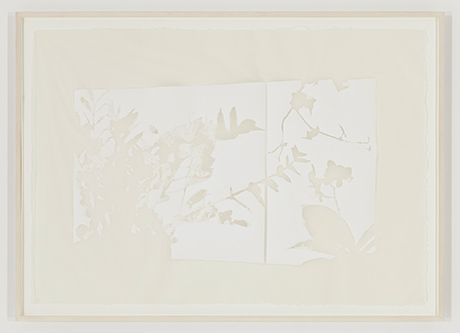
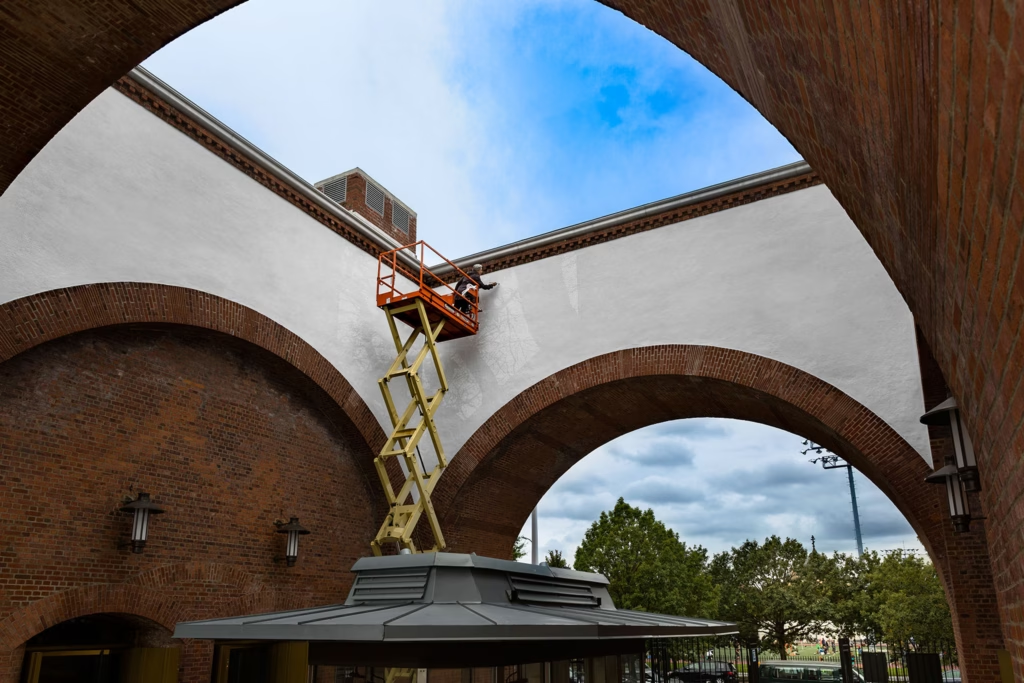
Aiming to interrupt the assuredness of architectural space and perceptual footing, Mary Temple makes work in, her own words, “the service of question and doubt.” She does so with a style of painting that teeters on the verge of invisibility – pursuing ethereal ends through disarmingly direct, yet inconspicuous means. Free of canvas, stretcher and frame, Temple paints directly onto architectural elements: moving beyond a purely visual exercise to congregate installation, environment and experience. The ensuing work redraws the expected parameters of painting in the same way Temple’s “organic” subject matter loosens the geometric certainties of her chosen structure. With a delicate, monochromatic touch, she creates the illusion of raking sunlight and silhouetted foliage stretching over walls, floors and columns. And while seamless realism is not her objective, the skill with which her “shadows” are painted often leads viewers to search for a nearby window as the source of the reflection. The only window that Temple opens however, is that into a hazy realm of memories triggered by the dreamy environs she evokes. Less “landscapes” than portraits of uncertainty, she explains, “The chance to create and then extend the time between belief and disbelief, when there is only doubt, is my primary reason for making this work.” This passage between seeing an apparent shadow, discovering it is something “other,” and struggling to locate the displaced origin is a fertile space where orientation becomes unmoored. Simply put, when expected anchor points slip, the entire system opens itself to reorganization.
In the mechanized realm of mass-produced items, Frances Trombly reasserts human presence through meticulous handicraft. From weaving and embroidery to crochet and cross-stitch, she employs traditional craft techniques to create objects that seemingly display none of the “aura” of quilts, textiles or tapestries. However, Trombly spends countless hours recreating items that are regularly produced with discard in mind, be they cardboard boxes, tarps, trash bags or party favors. That many of these objects are associated with domestic duties connects her work with a vein of 1970s Feminist Art that re-deployed household materials and processes into confrontational political vehicles. And yet, while Trombly shares the desire to challenge normative codes in Western society, her approach is deliberately more quiet and cryptic. Creating interruptions in the near-automatic consumption of consumer products, her work serves as an endearing lens to re-examine that which is so easily ignored. With a handloom, woven textiles and old world technique, Trombly cultivates an unfamiliar scrutiny of disposable objects that are habitually trashed or bypassed. Rather than sterile plastics and straightforward utility, she creates an unfamiliar intimacy with objects that invite reappraisal. In the process, Trombly endows the copy of a worthless item with an unexpected currency of labor, worth and “aura.” Stripped of “use value” but imbued with newfound “art value,” these domesticated Duchampian objects subtly, but poignantly appeal for time, and touch.
Exhibition Checklist Chul-Hyun Ahn Mu Rung Do Won (Infinite Garden), 2008 Plywood, lights, mirrors, plants, rocks, branches Courtesy of the Artist and C. Grimaldis Gallery, Baltimore Tunnel, 2008 Cement bricks, fluorescent light tubes, mirrors Courtesy of the Artist and C. Grimaldis Gallery, Baltimore Christian Andersson The Sistine Chapel (B.C.), 2009 Glass, wood, paper Courtesy of the Artist and Galerie Nordenhake, Stockholm Soft Drink Stand, 2001 Wall, slide projector, slide, light box, print, Plexiglas, paint Courtesy of the Artist and Galerie Nordenhake, Stockholm Daniel Arsham Building Cavity (Wall), 2007 EPS foam, plaster, paint, joint compound Courtesy of the Artist and Galerie Emmanuel Perrotin, Paris Curtain, 2007 EPS foam, plaster gauze Courtesy of the Artist and Galerie Emmanuel Perrotin, Paris
Kumi Yamashita Origami, 2005 Origami paper, aluminum, light, cast shadow Photo courtesy of the Artist and Kent Gallery, New York
Kumi Yamashita With an economy of gesture and accumulation of affect, Kumi Yamashita sculpts light to evoke unforeseen human presence. Starting with a variety of seemingly ordinary objects and materials, she crafts delicate contours that take on mystifying new life when subject to illumination. From origami paper and cardboard to thread, polystyrene and credit card impression, the fleetingness of her content reflects the artist’s philosophy toward both her practice and physical footprint. Born in Japan, she has since lived across Turkey, Mexico, Scotland, and various cities in the United States – believing that variability is more reflective of contemporary experience than constancy. As such, she lives, travels and works with a gossamer touch; making slight physical impressions to celebrate that which eludes apprehension. With little attempt to disguise the working process, she conjures portraits and profiles that are resonant and reticent at once. Often leaving one to ponder the location of the art object, Yamashita elaborated in a recent interview that she is most admiring of musicians who can fill a room with beautiful notes, and leave nothing behind. The meaning that her work subsequently inspires is much like a Beckett novel – using a spare, poetic approach to survey the “presence” of absence, anticipation and silence. The comparison to literature is also fitting to describe her unorthodox use of letters and figures: authoring cryptic formations that coalesce into alternative languages. In the process, apparent fragments are (re)shaped into fragile harmonies poised on the threshold of perception.
Tara Donovan Bluffs, 2009 Buttons, glue Courtesy of the Artist and The Pace Gallery, New York Untitled (Mylar), 2009 Mylar, hot glue Courtesy of the Artist and The Pace Gallery, New York Untitled (Paper Plates), 2006 Paper plates, glue Courtesy of the Artist and The Pace Gallery, New York Chris Dorosz The yellow pillow, 2010 Acrylic paint, monofilament, wood, steel weights Courtesy of the Artist and Leo Kamen Gallery, Toronto Tim Hawkinson Foot Quilt, 2007 Silver polyester fabric, Dacron batting Courtesy of the Artist and The Pace Gallery, New York Houston Exponential Function, 2010 Steel, wood, plastic, feathers Courtesy of the Artist/s The Narrative, 2010 Steel, wood, latex paint Courtesy of the Artist/s Rendition, 2006 Steel, wood, plastic, feathers, latex paint Courtesy of the Artist/s Jamie Isenstein Arm Chair, 2006 Wood, metal, nylon, raw cotton, linen, hardware, zippered jeans, “Will Return” sign Collection of Andrew Ong, Courtesy of Andrew Kreps Gallery, New York
Smoking Pipe, 2006 Pipe, wooden table, humidifier, sound insulation foam, hardware, glue, enamel Collection of Andrew Ong, Courtesy of Andrew Kreps Gallery, New York Magic Lamp, 2005 Plaster, gold leaf finish, epoxy, velvet curtain, magic light bulb, “Will Return” sign Collection of Stefano Basilico, New York Untitled (Curtain), 2008 Fabric, curtain rods Courtesy of the Artist and Andrew Kreps Gallery, New York Jorge Macchi Horizonte (Horizon), 2002 Nails, desk lamps Courtesy of the Artist and Galeria Ruth Benzacar, Buenos Aires Adam Putnam Blue Living Room, 2002 Plexiglas, theater gels, tripod, light bulb Courtesy of the Artist and Taxter & Spengemann Gallery, New York Doppelganger, 2007 Plexiglas, theater gels, light bulb Courtesy of the Artist and Taxter & Spengemann Gallery, New York Max Sudhues Nightskyliner, 2006 Slide projector, slide trays, desk lamp, carousel slide projections, mirror, plastic plant Courtesy of the Artist and Galerie Christian Lethert, Köln Mary Temple East Walls, Southwest Light (from the Light Installation series, 2002-present), 2010 Acrylic paint on existing architecture Courtesy of the Artist and Mixed Greens Gallery, New York Frances Trombly Blue, 2006 Crocheted cotton Courtesy of the Artist and Steven Wolf Fine Arts, San Francisco Confetti, 2005 Hand-crocheted cotton Courtesy of the Artist and Steven Wolf Fine Arts, San Francisco Extension Cord, 2007 Crocheted cotton Courtesy of the Artist and Steven Wolf Fine Arts, San Francisco Fallen, 2006 Hand-woven, hand-dyed silk, cotton fabric Courtesy of the Artist and Steven Wolf Fine Arts, San Francisco Kumi Yamashita Conversation, 1999 Polystyrene, motor, wood, light, cast shadow Courtesy of the Artist and Kent Gallery, New York Origami, 2005 Origami paper, aluminum, light, cast shadow Courtesy of the Artist and Kent Gallery, New York
Entrance
Hanes Home Dining Room Look Again, Group Exhibition Overlook Gallery Look Again, Group Exhibition
Potter Gallery GlassWear: Glass in Contemporary Jewelry, Group Exhibition Main Gallery Look Again, Group Exhibition
The curator wishes to thank all of the artists in the exhibition, for work that continues to reveal inspiring, and provocative new layers with every look. The galleries representing these artists have been steadfast in their support of this project, and deserve SECCA’s sincere gratitude. Look Again would never have achieved its first look without the invaluable dedication of the SECCA staff and SECCA Foundation board. Special recognition goes to Cliff Dossel and Mark Graves for their tireless efforts in building and securing the foundation on which this project could take shape. They received important assistance from John Blackburn and Gaby Cardall, who are as pleasant as they are professional. This project was also buoyed by the gracious volunteer support of Kristin Ashley, Aryn Leach and Kelsey Tsipis who we hope to enlist on many projects to come. Fifth Letter has designed the brochure you now hold, and deserve immense gratitude for their patience, poise, and unparalleled aesthetic sensibility. Posters, labels and wall text have been designed with matching skill and sophistication by Kate Merritt. Heartfelt thanks to Christine for love and listening, and a final thanks to all the patrons, donors, volunteers and visitors that meet SECCA at the intersection of art and you.
Reynolds American Inc. (RAI) and Womble Carlyle Sandridge & Rice, PLLC are the presenting sponsors for SECCA’s reopening celebration and the entire Summer @ SECCA program series. Special thanks also go to The Sundance Plaza Hotel, Spa and Wellness Center for their generous accommodation of the artists in this exhibition, and to the Village Tavern at Reynolda Village for their in-kind sponsorship. SECCA is an affiliate of the North Carolina Museum of Art, a division of the North Carolina Department of Cultural Resources. SECCA is also a funded partner of the Arts Council of Winston-Salem and Forsyth County. Presenting Sponsors:
Southeastern Center for Contemporary Art 750 Marguerite Drive Winston-Salem, NC 27106 t 336 725 1904 f 336 722 6059 www.secca.org
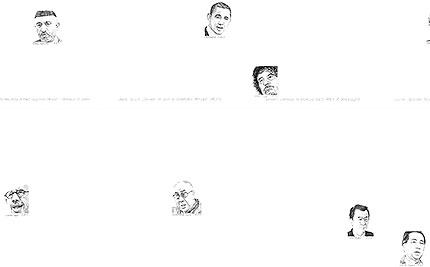
Mary Temple / April, 2011, from the Currency series, 2007present, 30 pages / each 16.5 x 13 in. Time-Lapse February 18 – May 20, 2012 Time-Lapse challenges the notion that an exhibition is a fixed entity with artworks that remain consistent throughout the time the exhibition is on view. Time-Lapse explores the possibility of a more dynamic exhibition environment by including artworks that change over time and utilizing curatorial structures that are based on change. With hourly, daily, and weekly alterations to the works in the show, no two days of Time-Lapse will be the same. Questioning the nature of time is a subtext for some of the works in the exhibition; other works question the nature of current curatorial practice by exploiting alternative time-based exhibition platforms such as the performance series or the Internet. Time-Lapse consists of works of art in which the notion of change over time is integral to the structure of the artwork itself. Mary Temple’s Currency is a drawing project the artist began on September 24, 2007 and has continued every day since. Temple creates a new drawing from images and headlines from various Internet news sites. She makes a portrait
of a political figure depicted in the news and creates accompanying text that is an amalgam of the headline and the image caption. During the run of Time-Lapse, Temple will scan her daily drawings and send a digital image to SITE, where the image will be printed out and added to a growing grid of drawings on the gallery walls. Byron Kim’s Sunday Painting is a project he has been engaged in since 2001. Each Sunday, Kim creates a painting of the sky from wherever in the world he finds himself. The skyscapes are coupled with diaristic text, creating a dialogue between the infinite and the everyday. Each week of TimeLapse, Kim will send a new Sunday Painting to SITE. Rafael LozanoHemmer will present a selection from a body of technological-based artworks he refers to as Recorders, which depend upon audience participation to take form. Pulse Index, for example, is an interactive installation in which participants fingerprints and heartbeats are recorded and become the visual and sonic material of the artwork. Eve Sussman and Rufus Corporation’s whiteonwhitealgorithmicnoir is an experimental film noir set in a dystopian “future-oplis” named City A. The film is edited in real time through a custom-designed computer algorithm that draws on 3,000 film clips, 80 voice-overs and 150 pieces of music. The film runs continuously with a constantly changing narrative that never presents the same juxtapositions of images, words, or music. Time-Lapse also incorporates curatorial models that emphasis the daily, weekly, or monthly changing of the artworks in the exhibition. These are epitomized by the March 2012 project and the Time Capsule Lounge. Time-Lapse is co-curated by Irene Hofmann, Phillips Director and Chief Curator, and Janet Dees, Assistant Curator. Special thanks to David Merrill for the design of the Time Capsule Lounge; Joanne Lefrak, Director of Education and Outreach and Juliet Myers, Curator of Public Programs for organizing programming in the Time Capsule Lounge; and to Jason Silverman, Director of CCA’s Cinematheque for organizing the film series in the Time Capsule Lounge.